




Stay Ahead with Prada Future Trends Predictions
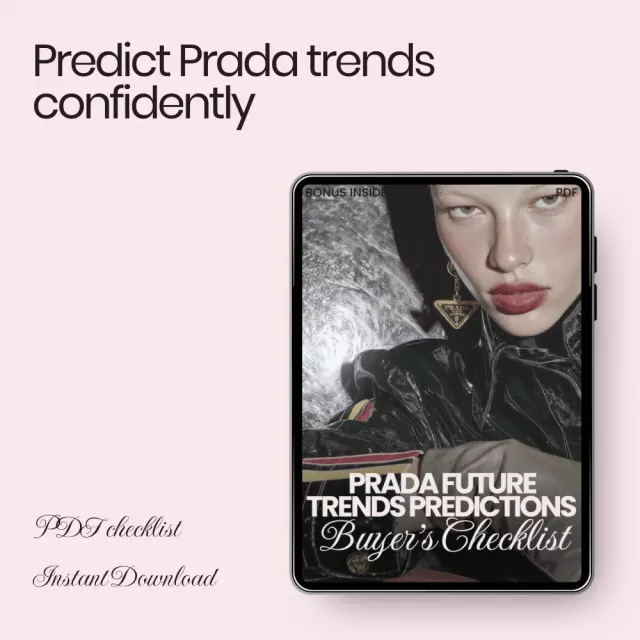
If you want to anticipate what’s next from Prada instead of reacting after trends explode, this Prada Future Trends Predictions: Buyer’s Checklist is your essential digital tool. Designed for fashion-forward thinkers, boutique owners, resellers, and style-conscious shoppers, this actionable checklist helps you decode runway signals, track innovation, and confidently invest in pieces that matter. With prada future trends predictions organized into a clear, easy-to-follow format, you’ll be equipped to evaluate what’s hype and what’s truly the future of fashion.
What You’ll Learn Inside
- How to track Prada’s sustainability direction and eco-collections
- How to spot emerging colors and evolving silhouettes
- Which footwear, bags, and limited releases signal demand
- How digital trends and collaborations forecast future collections
- How to assess market buzz to validate buying decisions
Who Is This For?
This checklist is ideal for fashion resellers, personal stylists, boutique owners, luxury collectors, trend forecasters, and ambitious entrepreneurs who want to use prada future trends predictions to make smarter buying decisions. Whether you curate inventory or build a personal wardrobe, this guide keeps you strategic and confident.
Why It’s Different
Unlike generic fashion trend reports, this digital download is structured as a practical buyer’s checklist. Instead of overwhelming you with theory, it gives you clear evaluation points you can immediately apply while shopping, sourcing, or planning inventory. It transforms prada future trends predictions into measurable action steps you can track season after season.
Practical Benefits
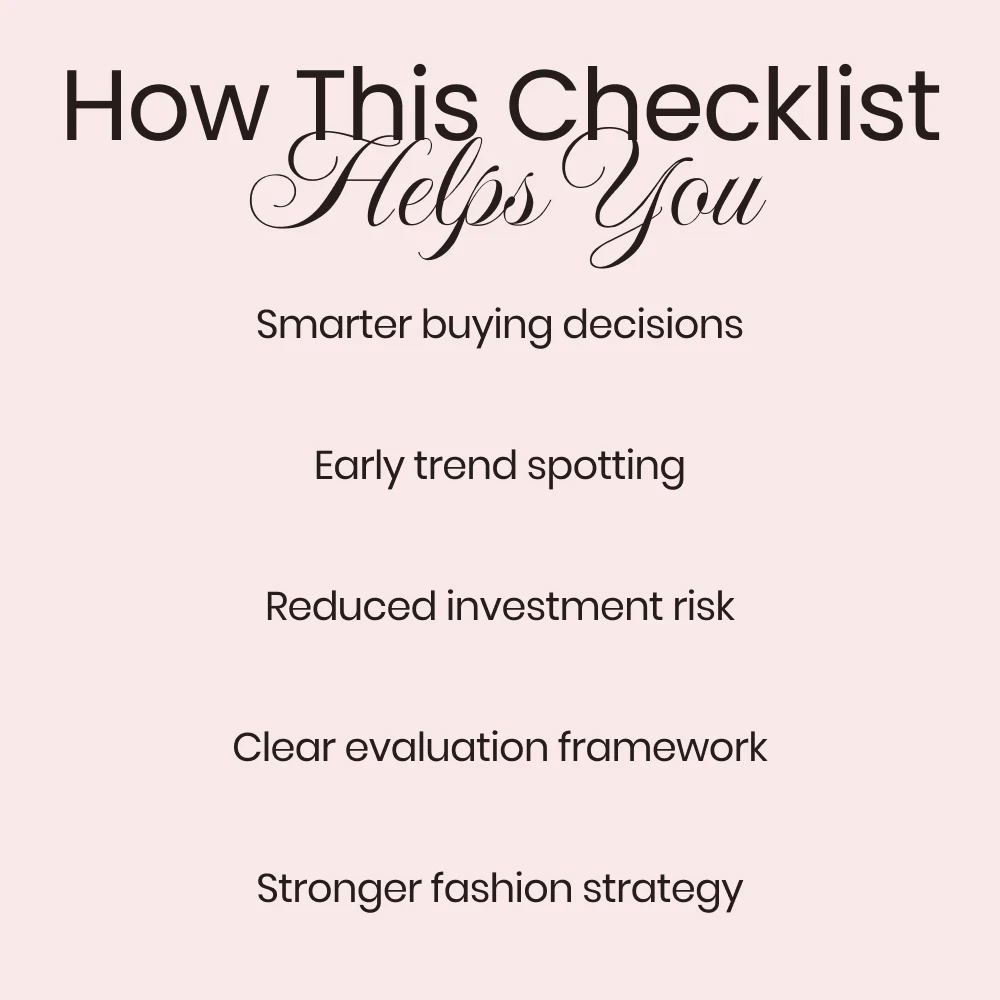
- Make smarter fashion investments with reduced risk
- Spot high-demand pieces before they sell out
- Align your boutique or wardrobe with future market direction
- Save time by focusing only on trends with real growth signals
- Build confidence in your luxury buying strategy
Download and Start Predicting with Confidence
Don’t wait for trends to peak before you act. Download Prada Future Trends Predictions: Buyer’s Checklist today and turn insider-level fashion insight into strategic advantage. Whether you’re curating, collecting, or building a business, this is your shortcut to staying ahead of Prada’s next move.
SHIPPING
We are proud to offer international shipping services that currently operate in over 200 countries and islands world wide. Nothing means more to us than bringing our customers great value and service. We will continue to grow to meet the needs of all our customers, delivering a service beyond all expectation anywhere in the world.
Do you ship worldwide?
Yes. We provide free shipping to over 200 countries around the world. However, there are some locations we are unable to ship to. If you happen to be located in one of those countries we will contact you.
What about customs?
We are not responsible for any custom fees once the items have been shipped. By purchasing our products, you consent that one or more packages may be shipped to you and may get custom fees when they arrive to your country.
How long does shipping take?
Shipping time varies by location. These are our estimates:| Location | *Estimated Shipping Time |
|---|---|
| United States | 5-20 Business days |
| Canada, Europe | 5-20 Business days |
| Australia, New Zealand | 5-20 Business days |
| Central & South America | 5-25 Business days |
| Asia | 5-20 Business days |
| Africa | 5-25 Business days |
Do you provide tracking information?
Yes, you will receive an email once your order ships that contains your tracking information. If you haven’t received tracking info within 5 days, please contact us.
My tracking says “no information available at the moment”.
For some shipping companies, it takes 2-5 business days for the tracking information to update on the system. If your order was placed more than 5 business days ago and there is still no information on your tracking number, please contact us.
Will my items be sent in one package?
For logistical reasons, items in the same purchase will sometimes be sent in separate packages, even if you've specified combined shipping.
If you have any other questions, please contact us and we will do our best to help you out.
RETURNS
Order cancellation
All orders can be cancelled until they are shipped. If your order has been paid and you need to make a change or cancel an order, you must contact us within 12 hours. Once the packaging and shipping process has started, it can no longer be cancelled.
Refunds
Your satisfaction is our #1 priority. Therefore, you can request a refund or reshipment for ordered products if:
- If you did not receive the product within the guaranteed time (45 days not including 1-3 day processing) you can request a refund or a reshipment.
- If you received the wrong item you can request a refund or a reshipment.
- If you do not want the product you’ve received you may request a refund but you must return the item at your expense and the item must be unused.
We do not issue the refund if:
- Your order did not arrive due to factors within your control (i.e. providing the wrong shipping address)
- Your order did not arrive due to exceptional circumstances outside the control of succella.com (i.e. not cleared by customs, delayed by a natural disaster).
- Other exceptional circumstances outside the control of succella.com.
*You can submit refund requests within 15 days after the guaranteed period for delivery (45 days) has expired. You can do it by sending a message on Contact Us page
If you are approved for a refund, then your refund will be processed, and a credit will automatically be applied to your credit card or original method of payment, within 14 days.
Exchanges
If for any reason you would like to exchange your product, perhaps for a different size in clothing, you must contact us first and we will guide you through the steps.
Please do not send your purchase back to us unless we authorise you to do so.
Order cancellation
All orders can be cancelled until they are shipped. If your order has been paid and you need to make a change or cancel an order, you must contact us within 12 hours. Once the packaging and shipping process has started, it can no longer be cancelled.
Refunds
Your satisfaction is our #1 priority. Therefore, you can request a refund or reshipment for ordered products if:
- If you did not receive the product within the guaranteed time( 45 days not including 2-5 day processing) you can request a refund or a reshipment.
- If you received the wrong item you can request a refund or a reshipment.
- If you do not want the product you’ve received you may request a refund but you must return the item at your expense and the item must be unused.
We do not issue the refund if:
- Your order did not arrive due to factors within your control (i.e. providing the wrong shipping address)
- Your order did not arrive due to exceptional circumstances outside the control of succella.com (i.e. not cleared by customs, delayed by a natural disaster).
- Other exceptional circumstances outside the control of https://succella.com
*You can submit refund requests within 15 days after the guaranteed period for delivery (45 days) has expired. You can do it by sending a message on Contact Us page
If you are approved for a refund, then your refund will be processed, and a credit will automatically be applied to your credit card or original method of payment, within 14 days.
Exchanges
If for any reason you would like to exchange your product, perhaps for a different size in clothing. You must contact us first and we will guide you through the steps.
Please do not send your purchase back to us unless we authorise you to do so.
Customer Reviews
Write a Review
We Think You’ll Love
Top picks just for you











Limited-edition eco-collections repositioned as long-term brand direction signals — that reframe changes how much weight they deserve at point of purchase.
Tracking muted pastels, earthy tones, and metallic accents from runway dominance through early retail drops gives color decisions a temporal structure most buyers never apply. The gap between runway appearance and retail visibility is where the framework creates the most useful advantage — the checklist surfaces it indirectly through how the color and market response sections connect.
Collaboration monitoring applied as a forward-looking framework — rather than as brand news to note and move on — is the most analytically distinctive section here. Prada's artist partnerships signal cultural register; tech brand partnerships signal product-line experimentation; designer partnerships signal aesthetic territory for the following season. Reading those three categories as separate forecast types rather than a unified collaboration signal produces more specific directional reads. The market response section adds the necessary validation layer: fashion blog coverage followed by influencer adoption timing followed by social velocity duration is more reliable as a compound signal than any individual channel. Tracking a Prada limited footwear release through that pipeline over six consecutive weeks produced a demand expansion signal two months before platform-level pricing reflected it.
AR try-on investment pointing toward enhanced material storytelling in subsequent physical collections — the digital-to-physical pipeline logic is more useful than it initially reads.
🌿♻️✨🔮👁️
Silhouette tracking — structured jackets, asymmetrical dresses, exaggerated outerwear — is organized and honest about positioning these as observation points rather than definitive trend signals. The gap is in guidance for how to weight silhouette signals against color and footwear indicators when they diverge, which happens across most buying cycles and is where the actual decision difficulty sits.
Statement sneakers tracked through limited release to social velocity — the footwear section maps that sequence more cleanly than most trend resources 👟
Virtual fashion and NFT collaborations repositioned as R&D signals rather than brand communications was the reframe I needed 🤖 Digital-first concepts that precede physical product developments are now the first thing I look for in any Prada tech announcement rather than the last.
Color palette evolution across the muted pastel, earthy tone, and metallic accent categories behaves differently as an investment signal in each — something this checklist surfaces without quite stating it explicitly. Metallic accents generate high early engagement with faster decline curves; earthy tones build more gradually and sustain premium resale positioning across multiple seasons. Muted pastels are the most difficult to read independently — they appear across multiple houses simultaneously, which makes Prada-specific positioning within that category more dependent on silhouette and material differentiation than on color alone. The runway-to-retail tracking methodology applied across four consecutive seasons has produced consistent early-entry timing advantages that platform monitoring alone hadn't.
Strong on sustainability and collaboration signals; the digital trends coverage needs updating to reflect where AR is actually landing in practice.
Reading who Prada collaborates with as a theme forecast for following seasons is a different skill than reading it as brand news.
The transformation in how I approach Prada buying cycles since working through this checklist is specific enough to be worth describing fully. Before, my methodology was reactive: I monitored platform-level engagement, noted pieces with rising demand, and positioned based on what had already surfaced. That sequence is directionally correct but consistently late — by the point a piece has demonstrated platform-level demand, the early-entry pricing and availability window has closed. The sustainability section reframed eco-collection releases as brand direction signals rather than product moments. Limited-edition recycled nylon pieces aren't just environmentally positioned product — they indicate where Prada's material innovation budget is concentrated, which historically precedes broader product line development in adjacent categories by one to three seasons. Bio-based fabric mentions in press materials alongside recycled nylon confirmed that the material investment commitment was dual rather than singular, changing how I weighted each type of eco-release as a directional indicator. The collaboration monitoring framework produced the most substantial methodology shift ✨ Separating artist partnerships, tech partnerships, and designer partnerships as distinct forecast types — each signaling a different dimension of upcoming direction — gave me a signal vocabulary I hadn't had. A tech brand collaboration that reads as a digital novelty in the moment will typically surface as physical product-line language twelve to eighteen months later — I've tracked that timeline across three Prada tech partnerships with consistent results. The digital-first section reinforced the same logic from the AR and virtual fashion angle: these aren't separate from physical product strategy, they're the earliest visible expression of it. The color section gave my decisions temporal structure: tracking which muted pastels and earthy tones dominated runway shows before retail appearances created an observation window that consistently preceded pricing pressure. The market response validation layer was the final component: sequencing social media reaction against influencer adoption timing against fashion blog coverage as three separate confirmation steps rather than a single engagement check produced meaningfully fewer false positives in my trend expansion reads.
Partnerships with tech brands as product-line experimentation signals rather than brand communications changed how I approach every Prada digital announcement. Compounding that with the collaboration category separation — artist, designer, tech each forecasting a different dimension — is where this checklist's analytical value concentrates most.
Clear on what to watch but thin on how to resolve competing signals, which is the actual challenge in most buying cycles.
Bio-based fabrics alongside recycled nylon framed as distinct material innovation signals — not interchangeable sustainability gestures — is the level of specificity that changes how you interpret eco-collection releases. Each points toward different supply chain investment priorities and different likely downstream product category development, and this checklist is one of the few trend resources that handles that distinction without collapsing them.
Market response assessment sequenced as fashion blog coverage, then influencer feature timing, then social engagement velocity — rather than monitored in parallel — is where this checklist's methodology departs most usefully from standard trend tracking. Each channel confirms at a different stage of demand development: editorial precedes broad awareness; influencer adoption confirms the piece is translating from runway to individual styling contexts; velocity duration distinguishes trends with expansion potential from sharp-peak noise 📈 Applied across five Prada accessory releases over two seasons, the composite signal was more reliable than social monitoring alone by a significant margin. The collaboration monitoring section adds a prior layer: pieces adjacent to an artist or designer partnership generate editorial attention faster than standalone releases, which compresses the observation window and requires adjusting the timeline accordingly.
Exaggerated outerwear tracked as a silhouette experiment rather than a product category positions it more accurately for investment decisions.
Seven sections logically sequenced, and the sustainability-to-collaboration-to-market-response flow functions as a coherent analytical framework rather than a list of independent things to watch. Explicit guidance on signal weighting when indicators conflict — eco-collection direction and NFT collaboration don't always point toward the same product future — is what would make this complete rather than comprehensive.
Metallic accent pieces fade faster than earthy tones hold — the color section implies that without stating it, and it's the most useful thing in it.
✨🌍🤝🔭💡
Classic tailoring and oversized experimental shapes aren't competing directions at Prada — they're two distinct customer registers addressed simultaneously from the same runway, and this checklist's instruction to track structured jackets separately from asymmetrical silhouettes captures that without needing to resolve the tension. Treating them as separate investment categories with different hold and exit logic is the more useful analytical frame.
High engagement as trend expansion signal is accurate but duration matters as much as volume — that distinction is absent here.
Compound signal from cross-referencing collaboration partner category with market response velocity has been more reliable than either alone across three consecutive buying cycles 🤝 Artist partnerships paired with rapid influencer adoption consistently produce longer trend arcs than tech partnerships with equivalent engagement — different holds, different exits, and this checklist structures the observations that make that distinction legible.
Sustainability as a forward-looking investment signal rather than a product attribute is the reframe this checklist makes most clearly. Limited-edition recycled nylon and bio-based fabric releases mark where Prada's material development attention is concentrated, which precedes mainstream product line expansion in those material categories by a predictable horizon. Tracked across two consecutive eco-collection releases, both preceded significant product category developments within eighteen months. The market response section adds the demand validation: when an eco-collection generates editorial coverage followed by influencer adoption — rather than editorial coverage alone — the sustainability signal is confirmed by consumer-side interest rather than brand intent, and the two together indicate a trajectory that either alone doesn't establish.
Fashion blog coverage followed by influencer adoption timing is a more reliable demand sequence than social engagement volume alone 📊