


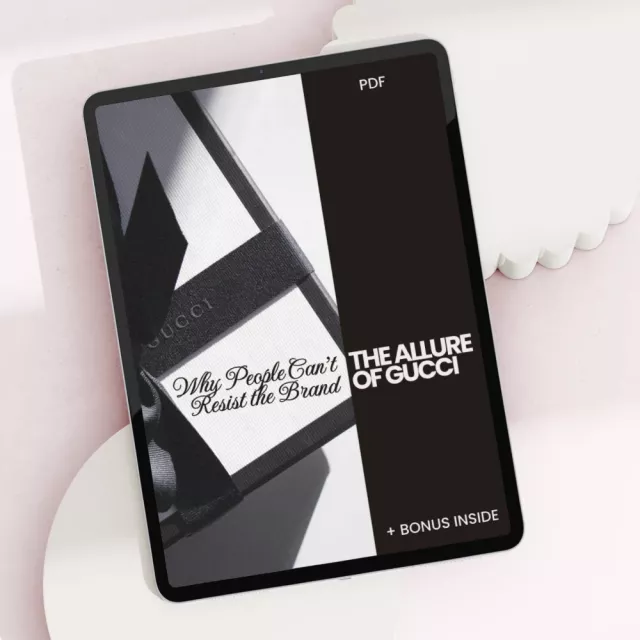
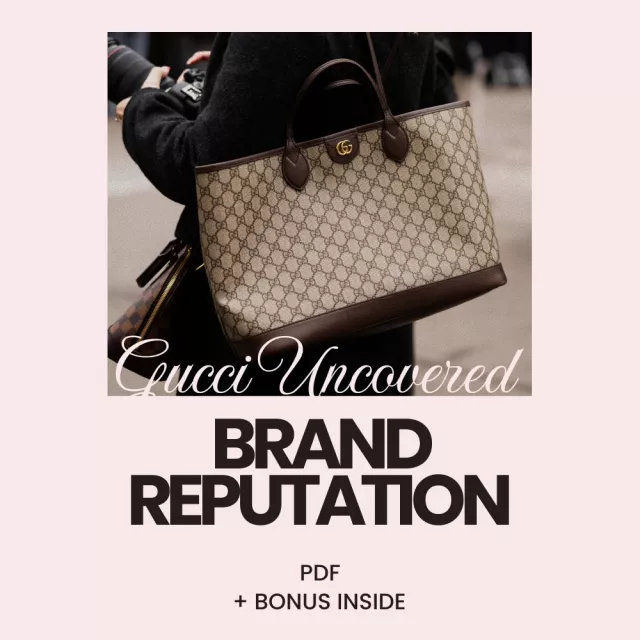
Unveil the Secrets of Gucci’s Iconic Brand Language
Step into the world of Gucci and discover how the luxury brand communicates its unique style to the world. With Gucci Speak: Decoding the Language of Luxury, you’ll explore the intricate strategies behind Gucci’s visual identity, social media influence, and storytelling power. This comprehensive guide reveals the inner workings of one of the most successful luxury brands, helping you understand how Gucci communicates its style across various channels. Perfect for marketers, fashion enthusiasts, and brand builders alike, this guide is your ticket to mastering the language of luxury.
In this easy-to-follow digital download, you’ll uncover valuable insights on how Gucci has shaped its global reputation and how you can apply these lessons to your own brand communications. Whether you’re a fashion brand looking to refine your messaging or a creative professional seeking inspiration, this guide will give you all the tools you need to decode the world of luxury fashion and branding.
What’s Inside: Key Features of the Guide
- Chapter 1: The Signature Voice of Gucci – Learn about Gucci’s brand identity, its visual language, and how storytelling shapes its legacy in fashion.
- Chapter 2: Communication Channels That Shine – Explore how Gucci utilizes social media, runway shows, and exclusive collaborations to amplify its message.
- Chapter 3: Practical Insights and Case Studies – Gain actionable knowledge from iconic campaigns and real-life examples of brand success.
- Chapter 4: Next Steps & Future Trends – Stay ahead of the curve with insights into AI tools, emerging trends, and tips for building your own brand voice inspired by Gucci.
Why You Need This Guide
This guide is more than just a collection of ideas; it’s a roadmap to understanding the sophisticated world of luxury fashion branding. Gucci Speak: Decoding the Language of Luxury is the go-to resource for anyone who wants to know how Gucci communicates its style with unmatched precision. With easy-to-follow examples and a breakdown of Gucci’s most successful campaigns, you’ll learn to avoid common mistakes that many brands make when crafting their message.
Whether you’re a brand manager, an aspiring entrepreneur, or just a lover of Gucci’s unparalleled style, this guide offers practical insights that you can implement immediately. It’s designed to help you build a brand voice that resonates with your audience and stays true to your identity, just like Gucci has done for decades.
Start Your Journey Now
Ready to unlock the secrets behind how Gucci communicates its style? Gucci Speak: Decoding the Language of Luxury is your must-have resource for mastering the art of fashion communication. Download your copy today and start building your own luxurious brand voice!
SHIPPING
We are proud to offer international shipping services that currently operate in over 200 countries and islands world wide. Nothing means more to us than bringing our customers great value and service. We will continue to grow to meet the needs of all our customers, delivering a service beyond all expectation anywhere in the world.
Do you ship worldwide?
Yes. We provide free shipping to over 200 countries around the world. However, there are some locations we are unable to ship to. If you happen to be located in one of those countries we will contact you.
What about customs?
We are not responsible for any custom fees once the items have been shipped. By purchasing our products, you consent that one or more packages may be shipped to you and may get custom fees when they arrive to your country.
How long does shipping take?
Shipping time varies by location. These are our estimates:| Location | *Estimated Shipping Time |
|---|---|
| United States | 5-20 Business days |
| Canada, Europe | 5-20 Business days |
| Australia, New Zealand | 5-20 Business days |
| Central & South America | 5-25 Business days |
| Asia | 5-20 Business days |
| Africa | 5-25 Business days |
Do you provide tracking information?
Yes, you will receive an email once your order ships that contains your tracking information. If you haven’t received tracking info within 5 days, please contact us.
My tracking says “no information available at the moment”.
For some shipping companies, it takes 2-5 business days for the tracking information to update on the system. If your order was placed more than 5 business days ago and there is still no information on your tracking number, please contact us.
Will my items be sent in one package?
For logistical reasons, items in the same purchase will sometimes be sent in separate packages, even if you've specified combined shipping.
If you have any other questions, please contact us and we will do our best to help you out.
RETURNS
Order cancellation
All orders can be cancelled until they are shipped. If your order has been paid and you need to make a change or cancel an order, you must contact us within 12 hours. Once the packaging and shipping process has started, it can no longer be cancelled.
Refunds
Your satisfaction is our #1 priority. Therefore, you can request a refund or reshipment for ordered products if:
- If you did not receive the product within the guaranteed time (45 days not including 1-3 day processing) you can request a refund or a reshipment.
- If you received the wrong item you can request a refund or a reshipment.
- If you do not want the product you’ve received you may request a refund but you must return the item at your expense and the item must be unused.
We do not issue the refund if:
- Your order did not arrive due to factors within your control (i.e. providing the wrong shipping address)
- Your order did not arrive due to exceptional circumstances outside the control of succella.com (i.e. not cleared by customs, delayed by a natural disaster).
- Other exceptional circumstances outside the control of succella.com.
*You can submit refund requests within 15 days after the guaranteed period for delivery (45 days) has expired. You can do it by sending a message on Contact Us page
If you are approved for a refund, then your refund will be processed, and a credit will automatically be applied to your credit card or original method of payment, within 14 days.
Exchanges
If for any reason you would like to exchange your product, perhaps for a different size in clothing, you must contact us first and we will guide you through the steps.
Please do not send your purchase back to us unless we authorise you to do so.
Order cancellation
All orders can be cancelled until they are shipped. If your order has been paid and you need to make a change or cancel an order, you must contact us within 12 hours. Once the packaging and shipping process has started, it can no longer be cancelled.
Refunds
Your satisfaction is our #1 priority. Therefore, you can request a refund or reshipment for ordered products if:
- If you did not receive the product within the guaranteed time( 45 days not including 2-5 day processing) you can request a refund or a reshipment.
- If you received the wrong item you can request a refund or a reshipment.
- If you do not want the product you’ve received you may request a refund but you must return the item at your expense and the item must be unused.
We do not issue the refund if:
- Your order did not arrive due to factors within your control (i.e. providing the wrong shipping address)
- Your order did not arrive due to exceptional circumstances outside the control of succella.com (i.e. not cleared by customs, delayed by a natural disaster).
- Other exceptional circumstances outside the control of https://succella.com
*You can submit refund requests within 15 days after the guaranteed period for delivery (45 days) has expired. You can do it by sending a message on Contact Us page
If you are approved for a refund, then your refund will be processed, and a credit will automatically be applied to your credit card or original method of payment, within 14 days.
Exchanges
If for any reason you would like to exchange your product, perhaps for a different size in clothing. You must contact us first and we will guide you through the steps.
Please do not send your purchase back to us unless we authorise you to do so.
Customer Reviews
Write a Review
We Think You’ll Love
Top picks just for you
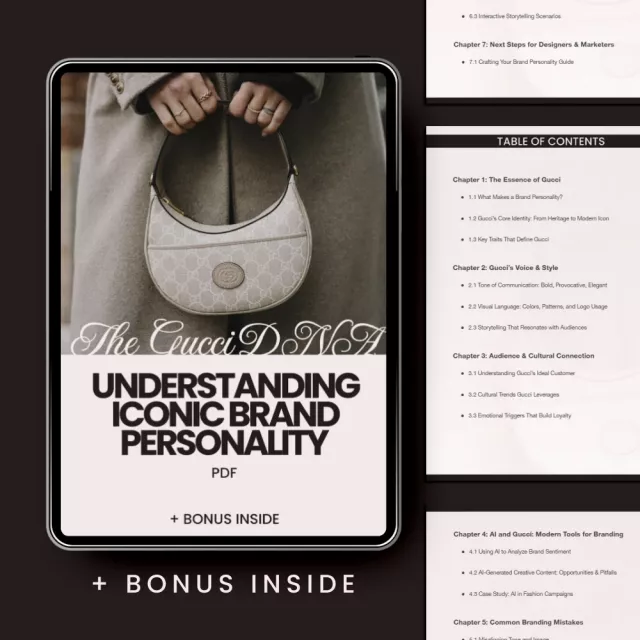











The brand personality chart exercise in Chapter 1 — listing adjectives that define your core essence — gave me a tool I use for every piece of content I create now. Such a simple framework with huge impact.
The Dionysus bag case study proved how visual cues carry brand identity without a single word.
Chapter 3's common mistakes table was the most actionable section — seeing inconsistent identity, trend chasing, ignored storytelling, and misaligned collaborations laid out next to how Gucci avoids each one gave me a direct audit framework for my own brand.
The storytelling chapter completely shifted how I think about campaigns 🔥
Good content on brand communication strategy. The AI prompt examples in Chapter 3 were creative but felt disconnected from the deeper branding insights in Chapters 1 and 2 — the transition between studying Gucci's approach and applying AI tools could be smoother. The campaign case studies are the strongest section.
The Gucci Bloom campaign breakdown was a masterclass in cohesive visual storytelling.
I run a small jewelry brand and this guide transformed my entire approach to communication. The section on visual language — logos, colors, patterns — made me realize my Instagram feed had zero consistency. I used the brand personality chart from Chapter 1 to define five adjectives for my brand, then audited every touchpoint like Chapter 3 suggested. The AI prompt about analyzing my own social media for visual consistency and tone produced insights I would have paid a consultant for. Within three weeks my engagement doubled because my feed finally told a coherent story instead of random product shots. The reminder that AI is a tool and not the final creative authority kept me grounded throughout the process.
Runway shows as narrative tools — that reframe alone was worth reading.
⭐⭐⭐⭐⭐
The section on how Gucci's social media feels like art rather than advertising reshaped my content strategy.
Covers branding principles well using Gucci as the lens. My one critique is that the AI sections across chapters repeat similar ideas — trend analysis, content creation, visual guidance — without going deeper into any single application. The brand identity and campaign analysis chapters carry the guide.
The collaboration examples — Gucci x Disney, Gucci x The North Face — showed exactly how partnerships extend storytelling.
Concise and applicable even for non-fashion brands.
The mistakes table in Chapter 3 is something I screenshot and reference weekly.
Solid branding guide but the Chapter 4 section on building your own brand voice felt rushed compared to the depth of the earlier chapters. The five-step framework is useful in principle but each step could use a worked example. The Gucci Bloom and Epilogue campaign analyses are where the real learning happens.
I studied marketing in college and this guide taught me more about luxury brand communication in an afternoon than an entire semester did. The concept of Gucci thriving on paradox — heritage and modernity, extravagance and playfulness — gave me a vocabulary for something I'd only sensed intuitively. The practical insight about designing mini-events or interactive showcases that tell a story rather than just displaying products directly inspired a pop-up I organized for my streetwear brand last month. The AI prompt examples in Chapter 3 were the bonus I didn't expect — I used the trend analysis prompt on my own Instagram and found recurring visual patterns I hadn't noticed. The mistakes table is now pinned above my desk.
The gender-fluid design discussion added a dimension most fashion guides ignore.
Short enough to finish in one sitting, dense enough to revisit.
The visual style guidance prompt — suggesting design variations in Gucci's aesthetic — gave my design team a starting point we'd been missing 🎨
The Epilogue campaign analysis showed how post-COVID messaging can still feel bold.
Good guide with smart insights on brand storytelling. The sustainability and ethics section in Chapter 4 is mentioned briefly but deserves its own deep dive given how central eco-conscious messaging has become in luxury. The campaign case studies and mistakes table in Chapter 3 are the real standouts.
The prompt for generating Instagram captions in Gucci's voice was surprisingly effective.
I keep returning to the three-word concept: exclusive inclusivity.
❤️👌🔥⭐✨👜
I came in expecting a fashion guide and got a brand communication playbook. The idea that Gucci sells experiences rather than products — and that campaigns should be narratives audiences can inhabit — fundamentally changed how I approach my own marketing. The Chapter 2 section on runway shows as immersive storytelling events made me rethink my product launches entirely. I now design mini-events around themes rather than just showcasing items. The AI prompt examples were practical enough to use immediately, and the five-step brand voice framework in Chapter 4 gave me a structure I reference before every campaign. The only thing missing is more non-Gucci examples to show how smaller brands have applied these same principles successfully.