


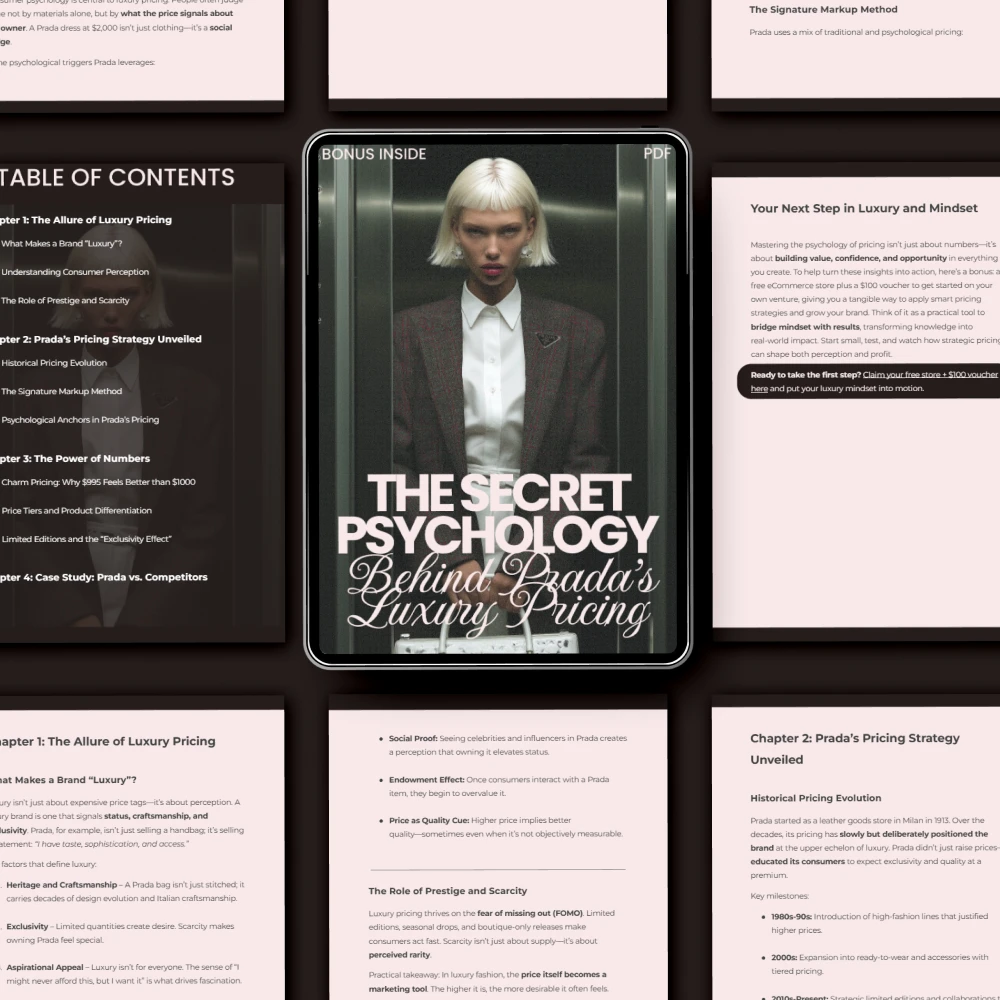




Unlock the Hidden Logic Behind Luxury Price Tags
Ever wondered why a Prada handbag priced at $995 feels more irresistible than one at $1000? The Secret Psychology Behind Prada’s Luxury Pricing reveals the subtle, powerful forces that shape how we perceive value, prestige, and exclusivity. This insightful ebook breaks down the prada pricing psychology that has helped transform Prada into one of the most influential luxury houses in the world. Whether you’re a fashion entrepreneur, brand strategist, marketer, or simply fascinated by high-end branding, this digital guide gives you an inside look at the numbers, strategies, and psychological triggers behind luxury success.
What’s Inside This eBook
- Chapter 1: The Allure of Luxury Pricing – What defines a luxury brand, how consumer perception is shaped, and why prestige and scarcity matter.
- Chapter 2: Prada’s Pricing Strategy Unveiled – Historical pricing evolution, the signature markup method, and psychological anchors in Prada’s pricing.
- Chapter 3: The Power of Numbers – Charm pricing, price tiers, product differentiation, and the exclusivity effect.
- Chapter 4: Case Study Comparison – Prada vs. Gucci vs. Louis Vuitton, including what works and key lessons for emerging brands.
- Chapter 5: Common Pricing Mistakes – Overpricing, discounting pitfalls, and cultural sensitivity errors.
- Chapter 6: AI in Pricing Psychology – How AI predicts willingness to pay and optimizes launch pricing.
- Chapter 7: Your Luxury Price Blueprint – Step-by-step strategy, AI prompts, and real-time testing methods.
- Chapter 8: Beyond Price – Marketing, storytelling, loyalty building, and when to adjust your strategy.
Who Is This For?
This ebook is perfect for fashion startup founders, luxury brand owners, ecommerce sellers, consultants, marketing students, and digital entrepreneurs who want to understand prada pricing psychology and apply similar principles to their own brands. It’s also ideal for anyone studying consumer behavior or exploring the intersection of AI and luxury fashion.
Why This Guide Is Different
- Combines real-world luxury case studies with clear psychological explanations
- Breaks down complex pricing theory into simple, actionable steps
- Includes practical AI prompts to help you set and test your own pricing
- Offers both strategic insight and hands-on implementation tools
- Focuses specifically on prada pricing psychology rather than generic pricing advice
Practical Benefits You’ll Gain
- Understand why certain price points increase perceived value
- Learn how to create exclusivity without alienating customers
- Avoid common luxury pricing mistakes that damage brand image
- Use AI tools ethically to refine your pricing strategy
- Build long-term brand equity through smarter pricing decisions
Download and Elevate Your Pricing Strategy Today
If you’re ready to move beyond guesswork and start pricing like a true luxury brand, this ebook gives you the clarity and strategy you need. Download The Secret Psychology Behind Prada’s Luxury Pricing today and discover how to transform perception into profit using proven prada pricing psychology principles.
SHIPPING
We are proud to offer international shipping services that currently operate in over 200 countries and islands world wide. Nothing means more to us than bringing our customers great value and service. We will continue to grow to meet the needs of all our customers, delivering a service beyond all expectation anywhere in the world.
Do you ship worldwide?
Yes. We provide free shipping to over 200 countries around the world. However, there are some locations we are unable to ship to. If you happen to be located in one of those countries we will contact you.
What about customs?
We are not responsible for any custom fees once the items have been shipped. By purchasing our products, you consent that one or more packages may be shipped to you and may get custom fees when they arrive to your country.
How long does shipping take?
Shipping time varies by location. These are our estimates:| Location | *Estimated Shipping Time |
|---|---|
| United States | 5-20 Business days |
| Canada, Europe | 5-20 Business days |
| Australia, New Zealand | 5-20 Business days |
| Central & South America | 5-25 Business days |
| Asia | 5-20 Business days |
| Africa | 5-25 Business days |
Do you provide tracking information?
Yes, you will receive an email once your order ships that contains your tracking information. If you haven’t received tracking info within 5 days, please contact us.
My tracking says “no information available at the moment”.
For some shipping companies, it takes 2-5 business days for the tracking information to update on the system. If your order was placed more than 5 business days ago and there is still no information on your tracking number, please contact us.
Will my items be sent in one package?
For logistical reasons, items in the same purchase will sometimes be sent in separate packages, even if you've specified combined shipping.
If you have any other questions, please contact us and we will do our best to help you out.
RETURNS
Order cancellation
All orders can be cancelled until they are shipped. If your order has been paid and you need to make a change or cancel an order, you must contact us within 12 hours. Once the packaging and shipping process has started, it can no longer be cancelled.
Refunds
Your satisfaction is our #1 priority. Therefore, you can request a refund or reshipment for ordered products if:
- If you did not receive the product within the guaranteed time (45 days not including 1-3 day processing) you can request a refund or a reshipment.
- If you received the wrong item you can request a refund or a reshipment.
- If you do not want the product you’ve received you may request a refund but you must return the item at your expense and the item must be unused.
We do not issue the refund if:
- Your order did not arrive due to factors within your control (i.e. providing the wrong shipping address)
- Your order did not arrive due to exceptional circumstances outside the control of succella.com (i.e. not cleared by customs, delayed by a natural disaster).
- Other exceptional circumstances outside the control of succella.com.
*You can submit refund requests within 15 days after the guaranteed period for delivery (45 days) has expired. You can do it by sending a message on Contact Us page
If you are approved for a refund, then your refund will be processed, and a credit will automatically be applied to your credit card or original method of payment, within 14 days.
Exchanges
If for any reason you would like to exchange your product, perhaps for a different size in clothing, you must contact us first and we will guide you through the steps.
Please do not send your purchase back to us unless we authorise you to do so.
Order cancellation
All orders can be cancelled until they are shipped. If your order has been paid and you need to make a change or cancel an order, you must contact us within 12 hours. Once the packaging and shipping process has started, it can no longer be cancelled.
Refunds
Your satisfaction is our #1 priority. Therefore, you can request a refund or reshipment for ordered products if:
- If you did not receive the product within the guaranteed time( 45 days not including 2-5 day processing) you can request a refund or a reshipment.
- If you received the wrong item you can request a refund or a reshipment.
- If you do not want the product you’ve received you may request a refund but you must return the item at your expense and the item must be unused.
We do not issue the refund if:
- Your order did not arrive due to factors within your control (i.e. providing the wrong shipping address)
- Your order did not arrive due to exceptional circumstances outside the control of succella.com (i.e. not cleared by customs, delayed by a natural disaster).
- Other exceptional circumstances outside the control of https://succella.com
*You can submit refund requests within 15 days after the guaranteed period for delivery (45 days) has expired. You can do it by sending a message on Contact Us page
If you are approved for a refund, then your refund will be processed, and a credit will automatically be applied to your credit card or original method of payment, within 14 days.
Exchanges
If for any reason you would like to exchange your product, perhaps for a different size in clothing. You must contact us first and we will guide you through the steps.
Please do not send your purchase back to us unless we authorise you to do so.
Customer Reviews
Write a Review
We Think You’ll Love
Top picks just for you
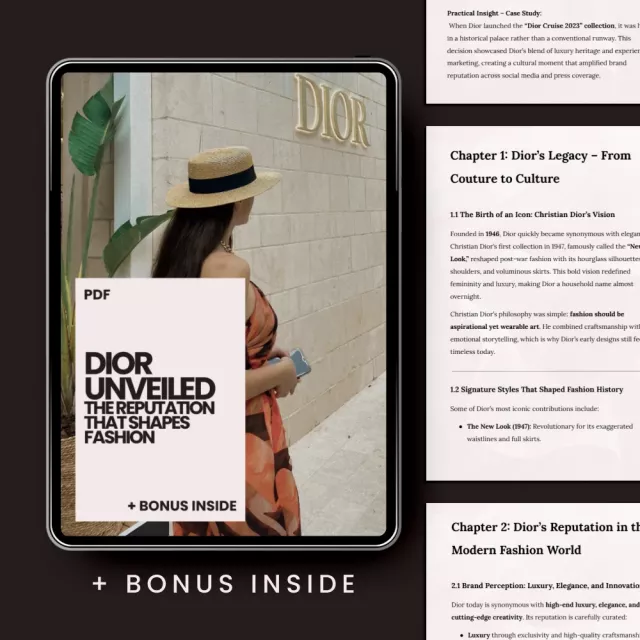

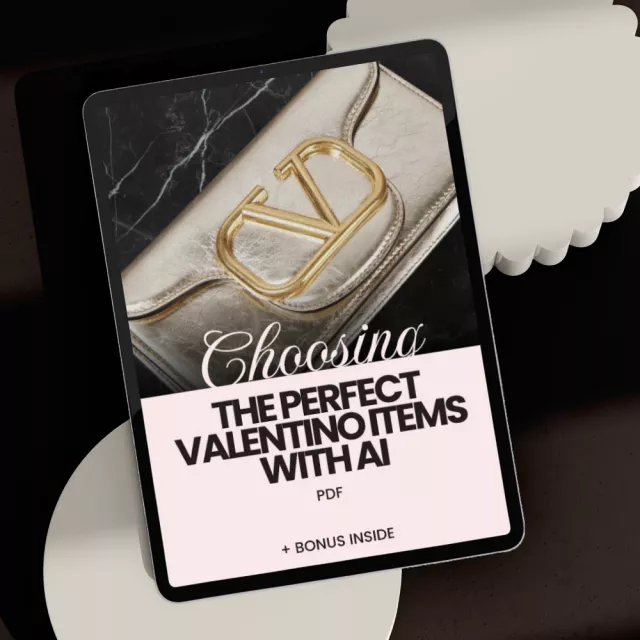
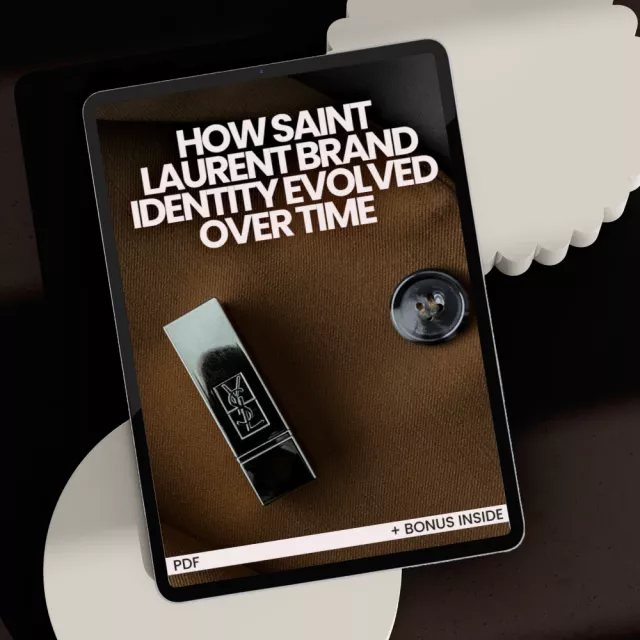












The five pricing mistakes section is where this guide earned its value for me. Every brand I've worked with has made at least two of them — most commonly overpricing without the perceived value to back it up, then discounting to compensate, which compounds the damage 💡 Seeing that pattern named clearly gave me language for client conversations that had previously been difficult to frame.
Soft launches at varied price points to test regional demand — deceptively simple, very powerful in practice.
I launched a luxury candle brand three years ago with no formal background in pricing strategy — just a strong product, some aesthetic credibility, and prices I'd set by benchmarking against competitors. Sales were inconsistent in a way I couldn't diagnose. The brand felt right, the product quality was legitimate, but something wasn't converting. Reading this guide was like having a conversation I'd needed much earlier. The anchoring concept was the immediate diagnosis: my highest-priced item was $180, which meant everything else in the range had nothing to push against. Introducing a $450 limited-edition gift set the following quarter changed the conversion pattern across the whole line within weeks — the $120 piece suddenly read as the smart, accessible choice rather than the expensive one. The section on the endowment effect — consumers overvalue a product once they've handled it — confirmed why our in-store sampling had always outperformed digital-only 🔑 The charm pricing section was smaller but surprisingly impactful: switching from round numbers to prices ending in 5 or 9 altered how the brand felt on the website without changing a single product. The section on discounting and brand dilution was the one I needed most urgently — I had been running quiet 20% promotions to clear slower-selling pieces, and the explanation of how this erodes prestige perception stopped that practice immediately. Twelve months later the brand is stocked in two boutiques and the resale section of our limited editions is active. I hadn't expected a guide on luxury psychology to have this direct an operational impact.
Price signals value; storytelling signals meaning — two lines that changed how I think about brand communication.
The section on building consumer loyalty — using early access and exclusive experiences rather than discounts to retain buyers — is well-argued and practically grounded. The tiered pricing framework is clear and the historical milestones are useful context. What I found missing was a more nuanced treatment of when price consistency should yield to market reality, particularly for newer brands navigating category positioning without established equity.
Boutique-only releases aren't just distribution choices — they're deliberate scarcity signals built into the pricing architecture.
The consumer loyalty section reframed entry-level products as loyalty gateways rather than brand diluters.
I study consumer behavior academically and had largely written off guides of this type as oversimplifications — this one genuinely surprised me. The treatment of the endowment effect is accurate and the social proof dynamics around celebrity and influencer use are well-observed. What made it practically valuable was the integration of individual concepts into a coherent system: the guide shows how anchoring, charm pricing, scarcity, and tier structure work together rather than in isolation. I'd been trying to explain to my research team why Prada's pricing architecture resists the race-to-the-bottom logic that erodes most consumer goods markets, and the three-brand comparison gave me the clearest framing I'd found. The honest treatment of pricing mistakes was particularly useful — understanding how discounting erodes prestige, and why misjudging regional sensitivities can be fatal, gave me real-world anchors for theoretical arguments I'd been making in more abstract terms.
Using AI to identify top collectors and offer early access instead of blanket discounts — that reframe alone.
This covers the psychological mechanics of luxury pricing with more specificity than most comparable resources. The charm pricing section is particularly sharp — the perceived precision point about prices ending in 5 or 9 was something I'd never seen explained this clearly. The guide is slightly more useful for people who already have a brand in place than for those building from zero, as the strategic advice assumes some level of existing market presence.
⭐💎🌟📈
I'd been building a luxury skincare brand for two years when I read this, and everything felt expensive but nothing felt luxurious — there's a real difference, and the guide names it in the opening section. The aspiration gap — the sense of 'I might never afford this, but I want it' — is the psychological engine my brand wasn't activating. My pricing had been too rational: based on ingredients, markup, and competitive benchmarking. The historical evolution section shifted my frame entirely. Prada didn't just raise prices; it educated consumers at each step to expect exclusivity, and that's the concept that drove our rebrand. We stopped trying to justify prices with ingredients and started telling the story of what the brand represented — sourcing, limited production, process. Within six months of implementing the three-tier structure, our average order value increased by 40%. The seasonal capsule concept from the exclusivity section directly informed a quarterly limited edition we launched, and the FOMO trigger played out exactly as described: the first edition sold out in eleven days. What proved most practically useful across the whole guide was the integration of AI tools into ongoing pricing strategy — specifically using secondary market activity as a feedback loop rather than just monitoring direct sales. We now track how our limited editions move on resale platforms as a real-time signal of brand desirability, which the secondary market validation section had framed as a reinforcement mechanism rather than an afterthought. The regional sensitivities section also saved us from a pricing error in a new market where we'd been planning to replicate our home pricing without adjustment. This guide did more to sharpen our brand positioning than any consultant we'd worked with.
The five-step pricing blueprint works as a diagnostic tool as much as a construction guide.
The concept coverage here is solid — anchoring, charm pricing, and the exclusivity effect are well explained, and the Prada versus competitors comparison is genuinely illuminating. Two things held it back for me: the AI section reads more like a preview than a developed framework, and the guide doesn't distinguish clearly between what works for an established house like Prada and what's actually transferable to a brand with two years of history and no institutional authority.
Monitoring resale trends as a real-time signal of brand health — that's the takeaway I'll carry longest.
The endowment effect in action: consumers overvalue what they've touched, even briefly, which is why in-store matters.
Reading how Prada's tiered pricing absorbs aspirational buyers while LV's price rigidity risks alienating younger segments clarified a pattern I'd observed in the market but never framed precisely. The closing section on knowing when to revisit a pricing strategy — launching new lines, responding to resale trend shifts, integrating fresh AI forecasting — gave me a practical review calendar I hadn't thought to build before.
Ignoring psychological triggers is the pricing mistake most guides skip entirely, and this one names it clearly — a technically excellent product can still fail to generate desire without anchors, scarcity, and tiered context working together. The practical blueprint is actionable and the AI prompts are a smart addition. What I'd want is a case study applying the full framework to a brand that isn't Prada, to demonstrate the principles working outside a legacy context.